02
1935 - 1939
Resistance, Love, and the Road to Exile
Dietrich’s transition into adulthood unfolded amid the radicalization of Nazi Germany. It encompassed the culmination of his professional training, extreme difficulties in the labor market, his marriage to Irmgard Ostberg, and the frantic bureaucratic race to escape Germany before the outbreak of war.
Professional Culmination and Job Search
Between 1934 and 1936, Dietrich completed his training as a commercial apprentice at the Oskar-Helene-Heim (OHH), the same institution where he had received medical treatment since birth. During this period, he attended the Berlin-Zehlendorf School of Commerce and Industry, where he achieved notable grades in accounting and typing, despite the increasing ideological indoctrination of the school curriculum.
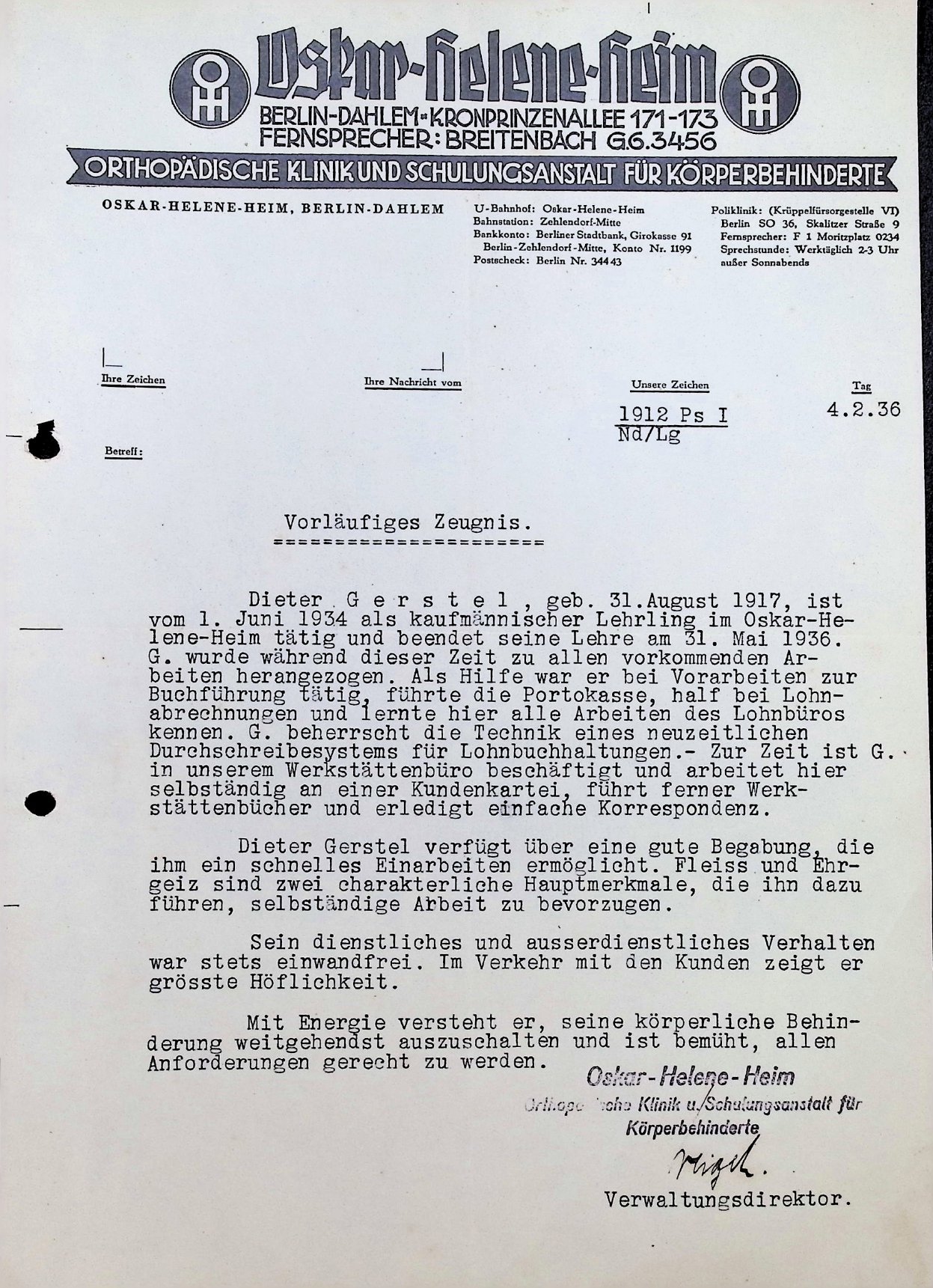
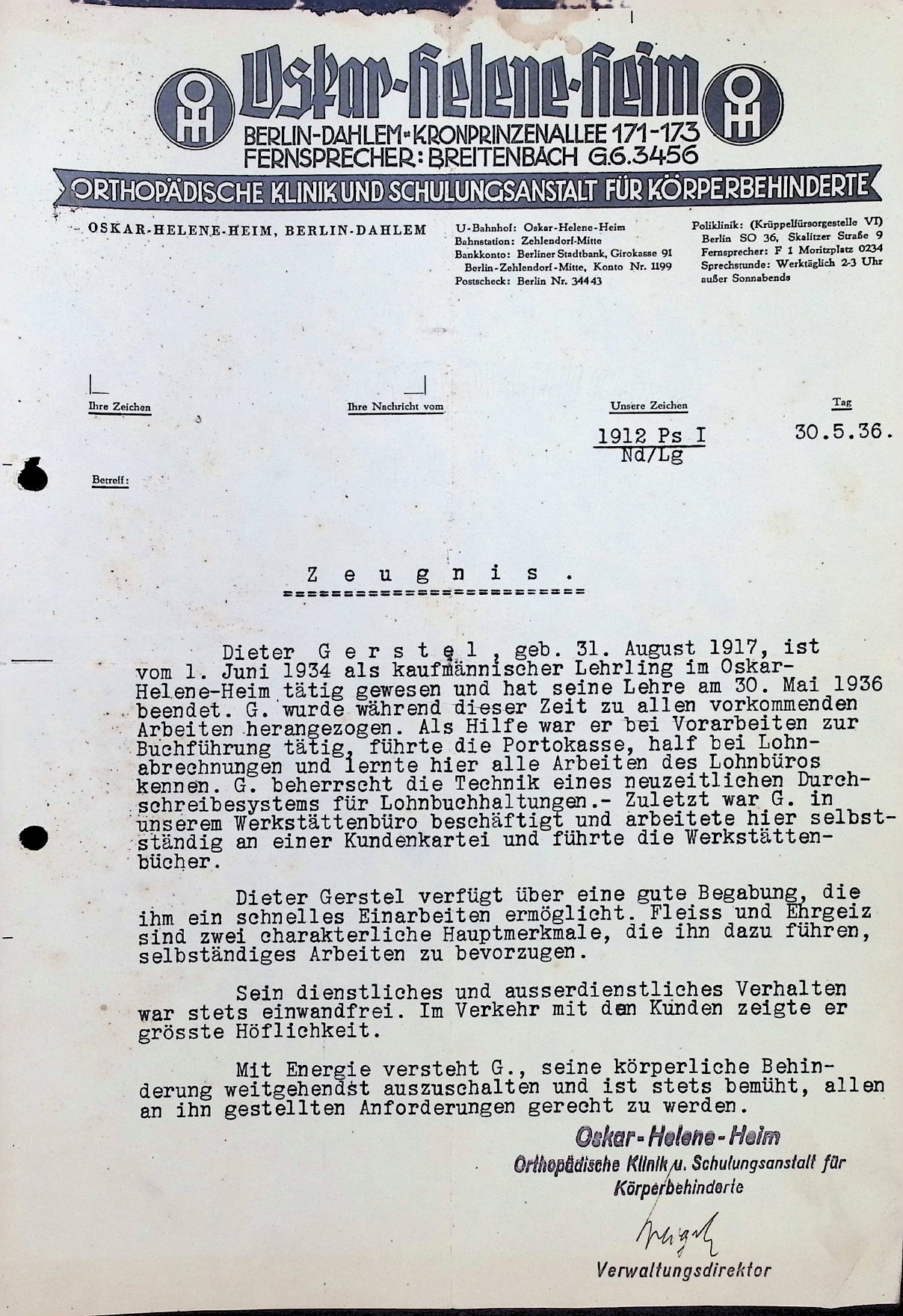
Upon completing his apprenticeship in May 1936, the OHH administration issued a certificate praising his diligence, ambition, and ability to overcome his physical disability through “great energy.” However, as the institution was incorporated into the German Labor Front (Deutsche Arbeitsfront), Dietrich was forced to withdraw due to his “non-Aryan” status.
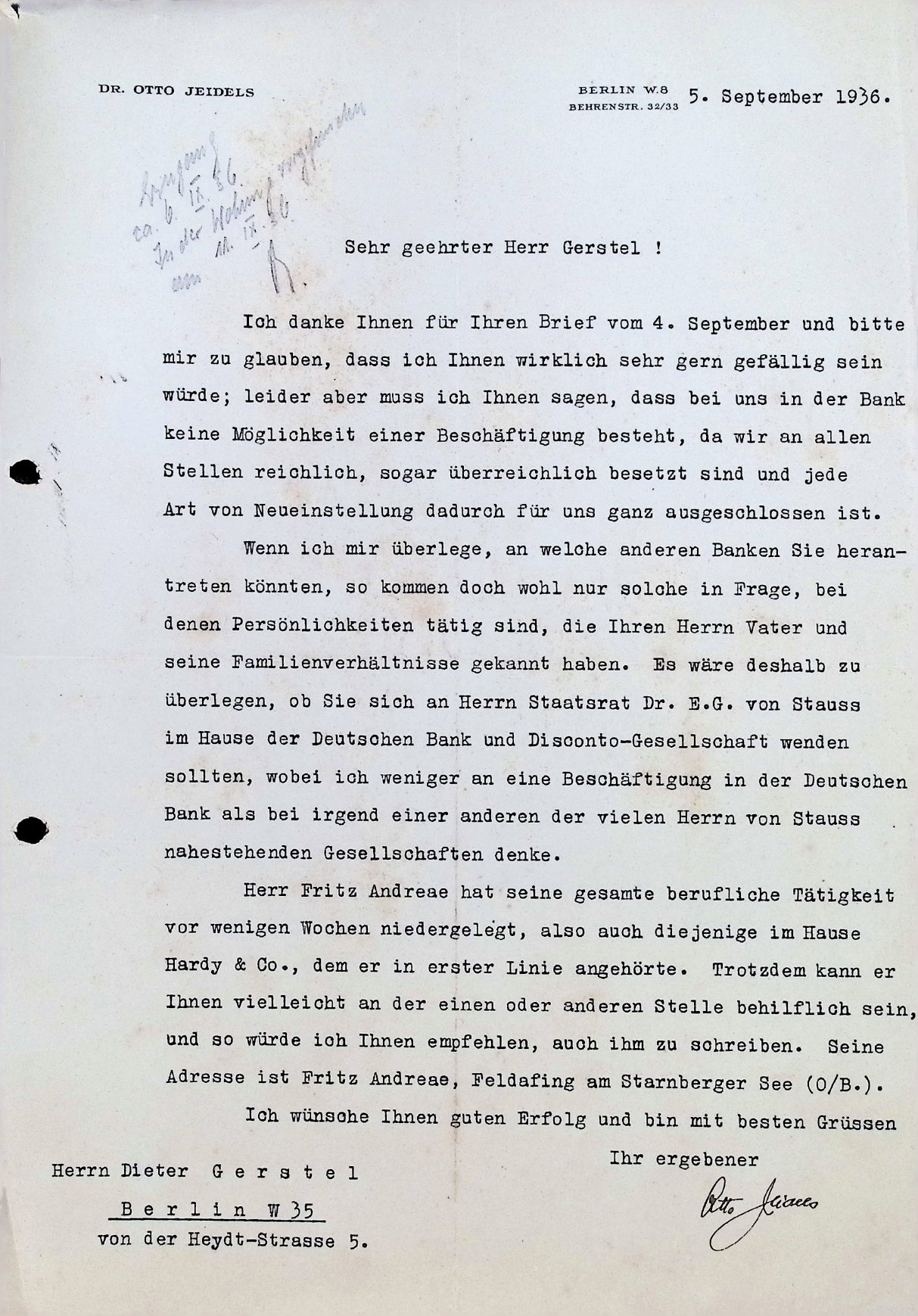
He then began an arduous job search, sending multiple letters to companies and banks, including the Berliner Handels-Gesellschaft and director Karl Morawe, requesting an opportunity. The responses were negative, revealing the systematic closure of the labor market to Jews, despite recommendations and the reputation of his late father.
The Experience at Kosmos Neuheiten
Finally, in April 1937, he managed to join the export firm Kosmos Neuheiten G.m.b.H., located in Berlin. He began as a volunteer with a symbolic remuneration of 50 Reichsmark (RM), later advancing to a permanent position with a salary of 100 RM. There he was responsible for accounting and cash management, demonstrating competence that his employers acknowledged in writing.
Nevertheless, the employment relationship deteriorated in March 1938. Facing imminent marriage and increased expenses, Dietrich requested a salary adjustment. The management’s response, signed by Ernst Neuberg, was humiliating, describing his hiring as an “act of charity” and denying the raise.
Dietrich resigned with dignity on March 31, 1938, closing his last formal work experience in Germany.
Humiliating letter from Ernst Neuberg denying the raise and calling his employment “charity.”
Personal Life and Marriage
On a personal level, Dietrich maintained a sentimental correspondence with Rosemarie Albers, a nurse at OHH, a relationship that eventually dissolved. Around 1936, while renting a room at the Ostberg family residence, he met Irmgard Ostberg, daughter of lawyer Ernst Ostberg. Their relationship solidified through an exchange of letters during the summer of 1936 and was formalized with their engagement in December 1937.
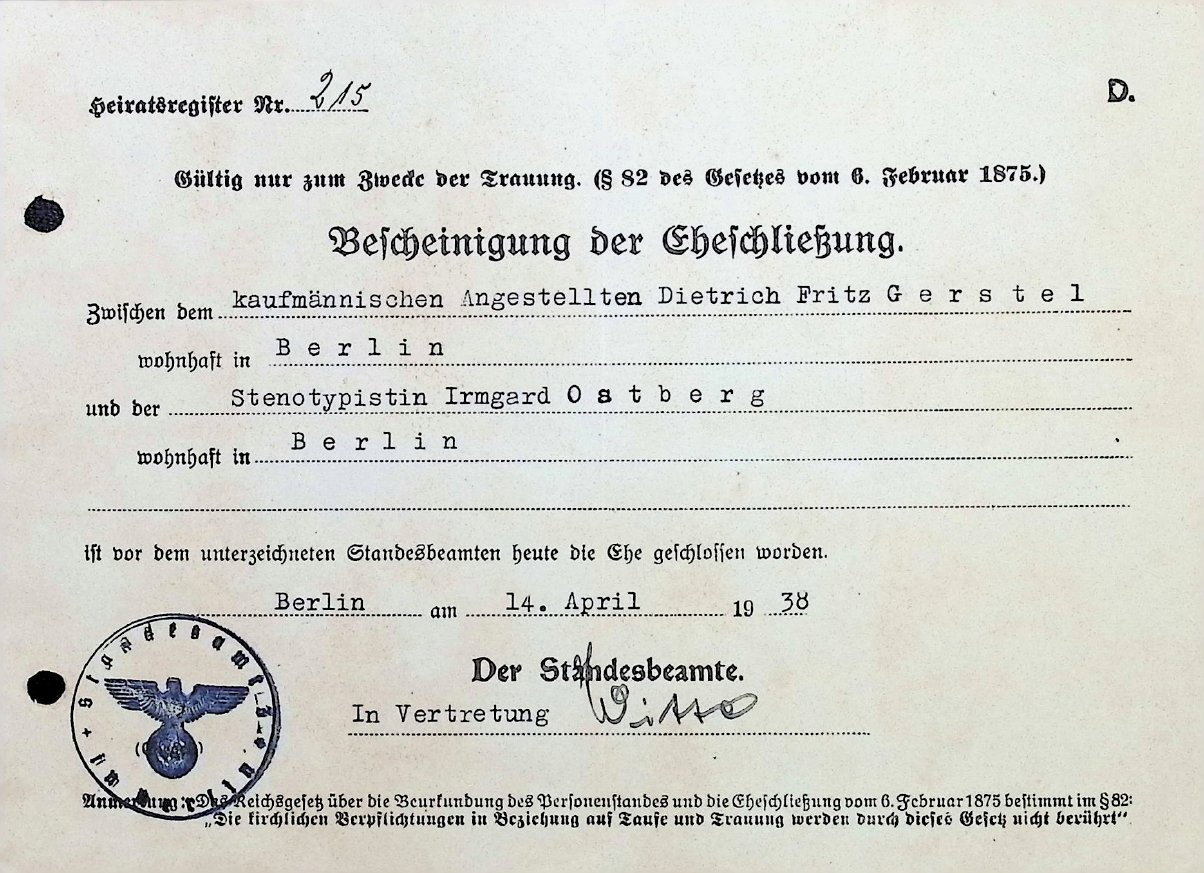
On April 14, 1938, Dietrich Gerstel and Irmgard Ostberg married at the Berlin-Tiergarten Civil Registry. The couple settled at Von-der-Heydt-Straße 6. This union took place in a context of growing hostility, representing an affirmation of life and future amid persecution.
Legal Encirclement and the “Night of Broken Glass”
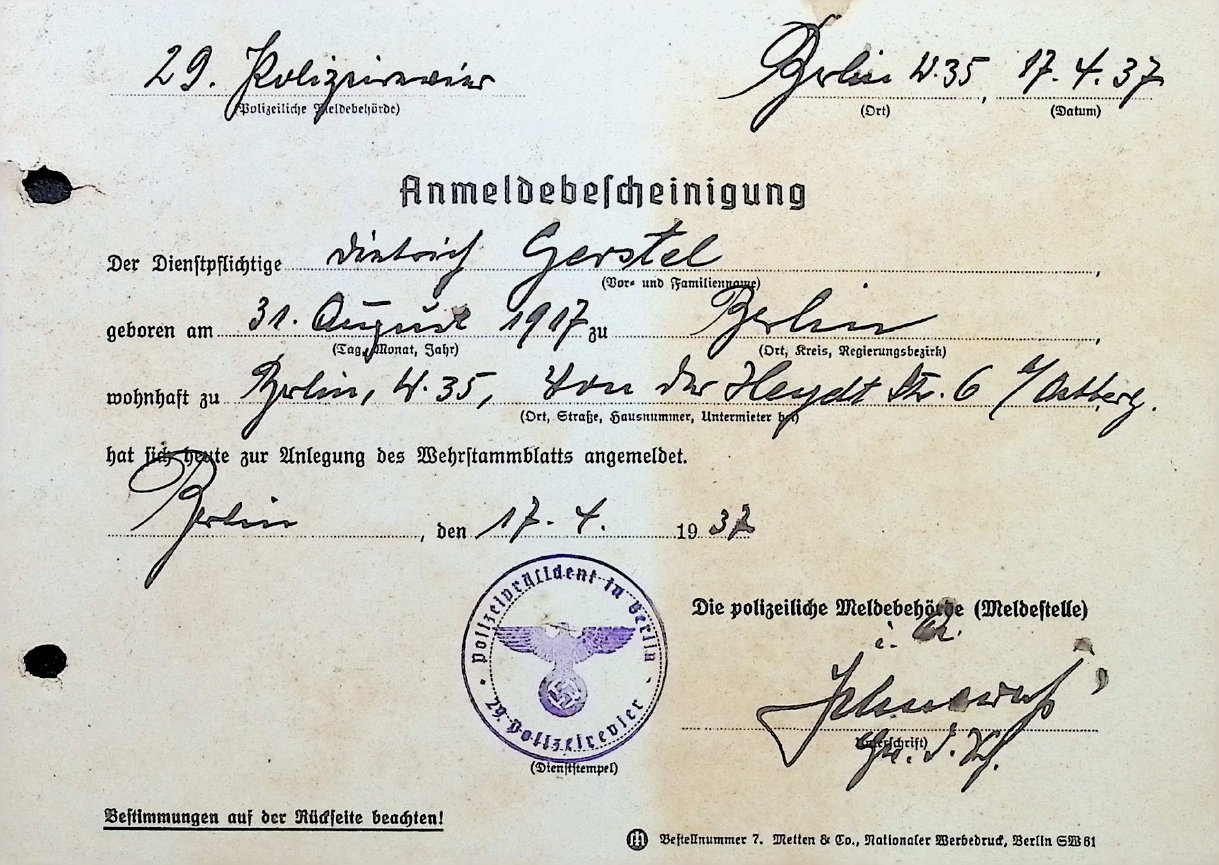
The pressure of the Nazi regime intensified drastically in 1938. Dietrich was summoned for military registration in July 1937, where he was classified in “Reserve II for Precaution” (Reserve der Vorsicht II) due to his ancestry (Abstammung), a form of administrative segregation.
By late 1938, persecution became suffocating. Following the decree eliminating Jews from economic life and the Kristallnacht (November 1938), Dietrich was forced to:
- Add the name “Israel” to his identity, while Irmgard had to add “Sara,” in compliance with the naming law.
- Surrender his driver’s license and vehicle documents in December 1938, losing the independent mobility he valued and had maintained by adapting his car.
- Submit to the confiscation of property and the blocking of bank accounts.
Preparations for Exile
Faced with the impossibility of remaining in Germany, the couple began frantic migration procedures. Dietrich considered options such as the United States (discarded due to restrictive immigration laws toward people with disabilities), Palestine, and England, without success. Ultimately, they decided on the route to Latin America.
The process involved collecting birth certificates of his ancestors, police certificates of good conduct, and medical examinations to prove fitness for travel. Despite financial difficulties, they managed to reserve passage with the Hamburg-Amerika Linie (HAPAG).
In January 1939, after obtaining “no objection” certificates from fiscal and labor authorities, Dietrich, Irmgard, and her brother Hellmuth boarded the M.S. Orinoco. They departed from Hamburg toward an uncertain destination, leaving behind their property, citizenship, and the life they had known, to disembark initially in Havana, Cuba.
Historical Documents
Provisional Certificate, O.H.H.
Record of skills acquired during commercial apprenticeship. Documents Dietrich’s competence in accounting and typing.
Reference Letter, O.H.H.
Final document praising his “great energy” in overcoming disability. Marks the end of his training before being forced to withdraw for being “non-Aryan.”
Employment Rejection
Letter from Otto Jeidels rejecting his application. Evidence of the systematic barriers in the labor market for Jews in 1936.
Employment Confirmation at Kosmos
Contract with Kosmos Neuheiten G.m.b.H. His only formal employment after apprenticeship, initially as a volunteer with 50 RM.
Military Registration Certificate
Classification in “Reserve II for Precaution” due to ancestry. A form of administrative segregation under the Nazi regime.
Wedding Rings Invoice
Personal document prior to marriage. Symbolizes hope and commitment amid persecution.
Salary Increase Refusal
Humiliating response from Ernst Neuberg describing his hiring as an “act of charity.” Precipitated his resignation.
Employment Termination
Final certificate from Kosmos Neuheiten. Marks the end of his formal working life in Germany.
Marriage Certificate
Official union with Irmgard Ostberg in Berlin-Tiergarten. An affirmation of life in a context of growing hostility.
Driving Ban for Jews
Decree by Heinrich Himmler eliminating driving licenses for Jews. Dietrich lost the independent mobility he had adapted to his disability.
Application for Additional Name for Jews
Forced compliance with the naming law. Dietrich added “Israel” and Irmgard “Sara” to their official identities.
Fiscal Non-Objection Certificate
Indispensable requirement certifying payment of confiscatory taxes. Without this document they could not leave Germany.
Certificate of Conduct and Criminal Record
Police certificate of good conduct required for emigration. Part of the bureaucratic labyrinth necessary to escape.
International Health Certificate
Medical document from HAPAG certifying his fitness to travel despite disability. Allowed him to board the M.S. Orinoco toward freedom.
Nuremberg Laws (1935)
Stripped Jews of German citizenship and prohibited “mixed” marriages. Legal foundation of systematic persecution.
Deutsche Arbeitsfront (1933–1945)
German Labor Front that replaced trade unions. Systematically excluded Jewish workers from all companies.
Kristallnacht (November 9–10, 1938)
“Night of Broken Glass.” Massive pogrom against Jews: 267 synagogues destroyed, 7,500 businesses looted, 91 killed, 30,000 arrested.
Naming Law (August 1938)
Forced Jews to add “Israel” (men) or “Sara” (women) to their names. A measure of humiliation and marking.
Jewish Emigration (1933–1939)
Approximately 282,000 German Jews emigrated before the war. The process was costly, bureaucratic, and humiliating.
M.S. St. Louis (May 1939)
Ship carrying 937 Jewish refugees rejected in Cuba and the U.S. Symbolizes the closing of borders. Dietrich departed only months earlier.
Jews in Germany (1938)
~400,000 (many had already emigrated).
Cost of Emigration
The Reich confiscated 80–90% of assets as a “flight tax.”
Kristallnacht Arrests
30,000 men sent to concentration camps.
HAPAG (Hamburg-Amerika Linie)
Main shipping company used for escape.
Reichsmark (RM) 1937
100 RM ≈ $40 USD (Dietrich’s monthly salary).
Passage to America
Cost several months of an average salary.
Contexto Histórico
Primera Guerra Mundial (1914-1918)
Dietrich nació durante el último año de la guerra, en una Alemania devastada por el conflicto y marcada por la escasez alimentaria.
República de Weimar (1919-1933)
Período democrático en Alemania caracterizado por efervescencia cultural, inestabilidad política y avances médicos significativos, como los del Oskar-Helene-Heim.
Crisis de 1923
Hiperinflación catastrófica en Alemania. Un pan llegó a costar 200 mil millones de marcos. La clase media perdió sus ahorros.
30 de enero de 1933
Adolf Hitler asume como Canciller de Alemania, marcando el fin de la democracia. En marzo se aprueban las primeras leyes antisemitas.
Ley de Restauración del Funcionariado (abril 1933)
Primera ley que expulsó a judíos de cargos públicos y profesiones liberales. Afectó directamente a Walter Gerstel en sus posiciones directivas.
1934: Año de consolidación nazi
Hitler elimina oposición interna y se proclama Führer. Miles de judíos alemanes comienzan a emigrar, aunque muchos aún confían en que “pasará”.
Datos Clave
Población judía en Alemania (1933)
~500,000 personas (0.75% del total)
Judíos en Berlín
~160,000, la comunidad judía más grande de Alemania
Tasa de suicidios judíos (1933-1945)
Aumentó más del 500%
Focomelia
Ocurre en 1 de cada 100,000 nacimientos
Oskar-Helene-Heim
Fundado en 1905, pionero en ortopedia pediátrica

